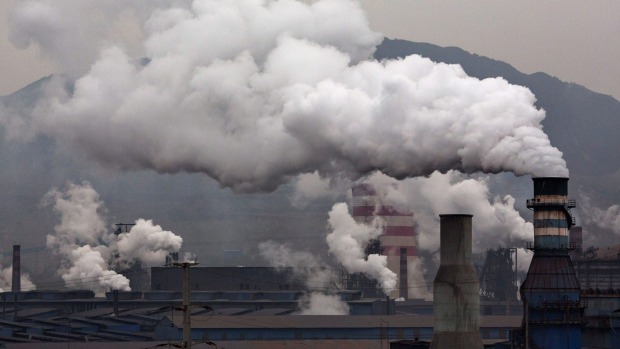

In the past 12 years, China’s economic structure has shifted dramatically, from excessive reliance on smokestack manufacturing industries to low-carbon services.
Back in 2006, the so-called secondary sector of gross domestic product (GDP) – largely manufacturing but also including construction and utility production — accounted for 48 per cent of Chinese GDP, while the tertiary, or services, sector accounted for just 42 per cent of total economic output. By 2018, the shares had been reversed – 41 per cent of GDP for the secondary sector and 52 per cent for services. For large economies, structural changes of this magnitude in such a short period are virtually unprecedented.
This shift was no accident.
In March 2007, former Premier Wen Jiabao famously warned of a Chinese economy increasingly becoming “unstable, unbalanced, uncoordinated, and unsustainable”. This sparked a vigorous debate over sustainability risks that had a big impact on China’s most recent five-year plans and reforms. The Chinese leadership concluded the economy could no longer afford to stay the energy and pollution-intensive course set by Deng Xiaoping’s hypergrowth gambit in the early 1980s.
Consistent with this dramatic structural transformation, China has been aggressive in shifting the mix of its fuel consumption away from carbon-intensive coal to oil, natural gas, hydro and renewables. Although coal still accounted for 58 per cent of China’s total primary energy consumption in 2018 – more than three times the 18 per cent share in the rest of the world – that is down sharply from 74 per cent in 2006, the year before Wen’s “Four Uns” first drew serious attention to sustainability.
Significantly, China is leading the world in embracing non-carbon renewables such as wind, solar, and geothermal biomass. In 2018, China’s renewables consumption was 38 per cent larger than that in the US and triple that of Germany. While renewables still account for just 4 per cent of China’s total primary energy consumption, they have been growing by 25 per cent annually over the past five years (including 29 per cent growth in 2018). If China remains on this path, then renewables could hit 20 per cent of China’s total energy consumption by 2025 – a big breakthrough on the road to a cleaner, less carbon-intensive economy.
China’s rapidly changing transport model is a third key component of its sustainability strategy. China has the world’s largest high-speed rail network, the fastest-growing subway system, and is leading all efforts in the rush to embrace electric vehicles. According to World Bank estimates, China is expected to exceed 30,000 kilometres of installed high-speed rail by next year, up from more than 25,000 kilometres by 2017, and to add considerably more in the years ahead. This energy-efficient mode of long-distance connectivity stands in sharp contrast to the carbon-intensive transport network created by the US interstate highway system in the 1950s and 1960s.
Boom in eco-cities
Finally, the urban environment – obviously critical to any sustainability challenge – is especially important in China where rapid urbanisation still has about three decades to go, with the urban share of its population likely to rise from nearly 60 per cent at present to 80 per cent by 2050. Yes, as in other countries, roads in China’s big cities are severely congested. But China is doing something about it, boasting seven of the world’s 12 longest subway networks. Moreover, China’s electric vehicles (EV) market dwarfs those elsewhere, with sales of over 500,000 EVs in 2017, versus slightly less than 200,000 in the US and Europe. And China’s EV lead is projected to widen considerably over the next decade.
China also stands out for its focus on a new eco-city urban model, featuring low-energy construction materials, light mass transportation, and well-planned “green space” urban pockets. The Xiong’an New Area, planned as a “subsidiary center” south of Beijing, is particularly noteworthy in this regard, as is the existing Sino-Singapore Tianjin Eco-city and Hainan’s recently announced plan to shift to all clean-energy vehicles. According to one recent estimate, China currently has plans to construct over 250 eco-cities. As a relative latecomer to urbanisation, China has the opportunity to rely on new models of city planning and energy efficiency that were not available to the first movers in the industrial world.
Is all this enough to make a difference for China and the planet? The good news is that China’s share of global emissions has flattened out, albeit at a high level. China’s share of global carbon dioxide emissions doubled from 14 per cent in 2001 to 28 per cent 2011, but has not increased since. While China’s CO2 emissions did rise by 2.2 per cent in 2018, that was less than in the US (2.6 per cent), Russia (4.2 per cent), and India (7 per cent) while falling well short of outright declines of 1.6 per cent and 2 per cent in Europe and Japan, respectively.
Alas, the good news in China is probably not good enough for a planet that many judge to be already in crisis. It’s one thing to bend the curve and stabilise the emissions share. It’s a different matter altogether to achieve the 20 per cent reduction in the level of emissions as originally stipulated in the 2015 Paris climate agreement. Nonetheless, by shifting away from carbon-intensive manufacturing to low-energy services, and embracing EVs, high-speed rail, and eco-friendly urbanisation – and being likely to stay the course on all these trends – China is setting a high bar for the rest of the world.
While the trade war is important, China is winning the far more important battle for sustainability. To its credit, China is focusing on this battle at a point when its per capita output is barely more than one-third the level in the so-called advanced economies. A relatively poor country has made a conscious choice to shift its focus from the quantity to the quality of growth.
What about the rest of us?